Showing posts with label electoral college. Show all posts

Monday, December 15, 2008

Barack Obama Elected 44th President

Federal law requires state electors to meet on the first Monday after the second Wednesday in December to cast votes for president and vice president. Electors are expected to vote for the winner in their state, but there is no federal law or Constitutional provision that requires them to do so, although some states have such requirements.

December 15th is the date when all of the Electoral College meets in the capitol of every state and the District of Columbia. The electors cast their ballots and the President of the United States is officially elected.

Based on the results from the November 4th election, the outcome was preordained, but it doesn't make the moment any less monumental.

Barack H. Obama is officially the President-Elect of the United States of America.

Entire Associated Press story:

RICHMOND, Va. (AP) — As 13 electors cast ballots Monday for the nation's first black president in the Confederacy's old Capitol, Henry Marsh emotionally recalled the smartest man he ever knew — a waiter, who couldn't get a better job because of his race.

"He waited tables for 30 years, six days a week, 12 hours a day, from 12 noon to 12 midnight, and he supported his family," Marsh, 75, a civil rights lawyer and state senator, said of his father as he fought back tears. "He suffered a lot. He went through a lot."

In all 50 states and the District of Columbia, the 538 electors performed a constitutional process to legally elect Democrat Barack Obama the 44th president.

More than 131 million voters cast ballots — the most ever in a presidential election. But Obama's election is not complete until Congress tallies the outcome of Monday's Electoral College vote at a joint session scheduled for Jan. 6.

Monday's voting was largely ceremonial, the results preordained by Obama's Nov. 4 victory over Republican Sen. John McCain. Obama won 365 electoral votes, to 173 for McCain. With every state reporting, all the electors had cast ballots in accordance with the popular votes in their states.

In many states, the formal, staid proceeding was touched with poignance, particularly among people old enough to recall a time when voting alone posed the risk of violence for black Americans.

The contrast at Virginia's Capitol, where the Confederate Congress met, was particularly striking.

Gov. Timothy M. Kaine noted in his speech that the 200-year-old Capitol was where lawmakers just 50 years ago orchestrated the state's formal defiance of federal school desegregation orders. But he also noted that it is where L. Douglas Wilder took his oath as the nation's first elected black governor in 1990.

"This temple of Democracy shines very brightly today," Kaine told a standing-room-only crowd attending what had always been a sparsely attended afterthought.

In Florida, state Sen. Frederica Wilson, 66, never thought she would see a black man elected president.

"White water fountains, colored water fountains. You couldn't sit at the lunch counter, go to the bank or get a hamburger," Wilson said after signing a document certifying that Obama got all 27 of her state's electors.

"The pain will always be there, but I think there's a realization that people have evolved," she said.

In North Carolina, 61-year-old Janice Cole said Monday's event was a joyous marker for black people to put old Dixie's trouble past behind them.

"Sen. Obama reminds us that only in America could this story be possible," Cole said.

As a pro football legend, Franco Harris signs his autograph countless thousands of times. But the signature he made as one of 21 Pennsylvania electors for Obama was the one the Pittsburgh Steelers great running back won't ever forget.

"That was special," the Pro Football Hall of Famer said. "This was the most valuable thing I've ever signed my name to."

In Augusta, Maine, the moment was freighted with emotion for Jill Duson, the first black mayor of Portland and chairwoman of Maine's four electors.

"Every time I think of it, I get a little misty eyed," Duson said. "I am undone by the election of Barack Obama and what it says to me as a black American, and his victory in the whitest state."

Sedrick Rawlins, a retired 81-year-old dentist from Manchester, Conn., traveled to Selma, Ala., in 1965 to help the Rev. Martin Luther King Jr., with the bloody march to Montgomery. The night Obama won the election, he said, he wept with joy. On Monday, he couldn't stop smiling.

"The election is one thing, but it's really official when they seal those ballots with wax and send them off," Rawlins said.

Colorado elector Wellington Webb, Denver's first and only black mayor, said the chance to cast an electoral vote for the first black president was the honor of a lifetime, one that would have made King proud.

"He would find the dream fulfilled," Webb said.


~ ~ ~

Excerpts of Deseret News story out of Salt Lake City, Utah:


In Salt Lake City, members of Utah's Electoral College cast their five presidential votes for Sen. John McCain, R-Ariz.

The five Republican electors unanimously voted for McCain in the Supreme Court chambers at the state Capitol. The electors also unanimously voted for Alaska Gov. Sarah Palin for vice president.

While some states held large celebrations to mark the historic occasion of electing the nation's first black president, Utah's ceremony attracted only about two dozen observers, most of whom were news reporters or staff in the Lieutenant Governor's Office, which administers elections.

The entire ceremony took about 10 minutes and President-elect Obama was not mentioned once.

McCain was heavily favored to win Utah's five electoral votes after winning the Republican nomination. He won the popular vote in state in November with 62 percent of the vote.


~ ~ ~

plez sez:

God Bless Barack Obama.

God Bless the United States of America.

~ ~ Citations ~ ~

Read the USA Today article about the Electoral College vote.

Read the Times Union article about the Electoral College vote.

Read the CNN.com article about the Electoral College vote.

Read the Fox News article about the Electoral College vote.

Read the Associated Press article on Yahoo! News about the Electoral College vote.

Read the Deseret News article about the Electoral College vote in Utah.

Read the AOL News article about the Electoral College vote.

~ ~ ~ ~ ~ ~


Monday, November 03, 2008

Obama-McCain Electoral Showdown in One Day

The Sunday afternoon before the first Tuesday in November... in 2008.

Sen. Barack Obama is exhorting his supporters to get to the polls on Tuesday, "I don't win if you don't vote on Tuesday."

Sen. John McCain is exhorting his supporters to continue the "good fight," he's comeback many times before and this time will be no different (unless there's a repeat of 2000 when George W. Bush took him out in the Republican primaries).

~ ~ ~

According to just about every model that has been published, Barack Obama is nursing a substantial lead in the national polls and the key battleground states that he needs to win. FiveThirtyEight.com predicts about 332.9 electoral votes, based on their polling.

John McCain has only one option to be elected the 44th President of the United States, he must win ALL of the battleground states that were won by George W. Bush in 2004! Right now, he is trailing Obama in the following Bush 2004 states: Ohio, Virginia, North Carolina, Colorado, New Mexico, and Nevada... and Florida is a dead heat! He is slightly ahead in Indiana, Missouri, and Montana.

Early voting has Obama putting pressure on McCain to get out the vote in such crucial states as Georgia, North Carolina, Ohio, and Virginia. And remember, McCain must win ALL of the Bush 2004 states in which he is currently trailing! The only non-Bush 2004 states that are "in play" for McCain according to the pollsters are New Hampshire and Pennsylvania for a grand total of 25 electoral votes.

FiveThirtyEight.com Electoral Map as of 11/2/2008

11/02/2008 Update from fivethirtyeight.com
Polls conducted since our update last evening suggest some tightening toward John McCain, but he sits well behind both nationwide and in many key battleground states and remains a long-shot to win the election.

The good news for McCain? SurveyUSA has become the latest pollster to show the race tightening in Pennsylvania, now giving Barack Obama a 7-point lead after he'd been in the mid-double digits at various points in October. The Muhlenberg/Morning Call tracker has also continued to tighten, also settling on that 7-point number.

SurveyUSA also has Virginia tightening a bit to 4 points. And McCain gained incrementally in the Research 2000, Gallup, and Diageo/Hotline trackers, although this comes after a couple of days when Obama had been moving up. (Rasmussen held steady, whereas Obama ticked up in Zogby).

Overall, our model shows McCain closing Obama's gap in the national popular vote to about 5.4 points. His win percentage has increased to 6.3 percent, from 3.8 percent last night.

However, several cautions about reading too much into these numbers:

Firstly, I have the model programmed to be EXTREMELY aggressive this time of year. There have been relatively few 'fresh' polls conducted within the past 24-48 hours -- most of these state polls were in the field late last week. As we get more data in today and tonight, the model could very well decide that the race is not tightening at all. Moreover, polling conducted on a weekend -- particularly on a quasi- holiday weekend -- is generally unreliable.

Secondly, even with this tightening, McCain remains well short the 2/2/2 condition that we defined last week:
John McCain polling within 2 points in 2 or more non-partisan polls (sorry, Strategic Vision) in at least 2 out of the 3 following states: Colorado, Virginia, Pennsylvania.
Indeed, McCain has not come within 2 points of Obama in any polls in any of these states.

Finally, where McCain has made progress, it has come mostly from undecided voters rather than Obama's support -- this is particularly the case in Pennsylvania. Therefore, he may be running out of persuadables to persuade.


In a surprise move, it appears that normally red Montana has been moved to the "tossup" category by CNN.com.

CNN Electoral Map as of 11/2/2008

CNN.com writes of "tossup" Montana:
Call it the battle for Big Sky country.

George W. Bush won Montana by 20 points in his re-election victory four years ago. But it seems times have changed in the state.

CNN's new Electoral College map, updated Sunday morning, moves Montana from "leaning John McCain" to "tossup."

The move is partially based on the new CNN poll of polls in Montana, compiled Friday, which suggests that McCain has a 1-point lead over his Democratic rival, Barack Obama, 46 percent to 45 percent. Nine percent of voters are undecided.

"The fact that Montana is up for grabs has to be extremely unsettling for the McCain campaign," said CNN Senior Political Researcher Alan Silverleib.

"Montana's usually a reliably Republican state in presidential campaigns. It's been won by the Democrats only twice in the past half century. If you're a Republican and you're fighting for Montana in the last few days of the campaign, you're not in good shape."

Three electoral votes are at stake in Montana, a state Obama visited in late August. McCain, the Republican nominee, has not campaigned in Montana during the general election.

With Montana moving to "tossup," CNN estimates that if the election were held today, Obama would win states with 291 electoral votes -- more than enough to capture the White House.


~ ~ ~ ~ ~ ~


Read the FiveThirtyEight.com article about updated polling for 11/2/2008.

Read the CNN.com articles about Montana being in play and its final poll before the election.

Read the CNN.com article about the Republican Party of Pennsylvania's "unauthorized" last minute Rev. Wright ad attacking Obama.

Read the New York Times articles about winning what was lost in 2004 and Obama's angst about being up in the polls.

Read the Washington Post article about Obama's projected electoral lead.

~ ~ ~ ~ ~ ~


plez sez: this will easily be the most exciting election of my forty-something years! the battle is between a Black guy who could just as easily be a close friend or cousin and an elder statesman white guy who is older than ronald reagan when he won the presidency!

the dynamics of watching an American dream unfold before our eyes: a Black guy born of a Kenyan father and a mother from Kansas, born in a country before Black people could vote in some parts of the country. we've literally watched BARACK OBAMA become a statesman before our eyes, as we watched him enthrall the crowd during the 2004 Democratic National Convention to his numerous debates with Sen. Hillary Clinton to his address on race to his massive community organization effort to mobilize millions on his behalf to his staring down the elder statesman to his becoming a world figure to his being on the cusp of becoming the Leader of the Free World!

my heart races in anticipation. you have no idea the fall that i've set myself up for if OBAMA does not win on tuesday. it will be a calamitous crash of monumental proportion... one which will probably involve years of therapy for full recovery!

the polls are pointing to an OBAMA win. the stars are aligned. history is waiting for OBAMA to inscribe the next chapter of America... a new America. An America for ALL, regardless of race, class, or station.

~ ~ ~
plezWorld will be working on November 4th to ensure that everyone in my community who wants to vote, gets to vote.

i spoke to my mother a few days ago. she grew up in the segregated south (north carolina) in the 30's and 40's.

Black people weren't allowed to vote back then.

my mother and father didn't get a chance to vote until they moved our family to new york in the mid-1950's. i was born before the Civil Rights Act of 1965. i was born before it was illegal to deny Black people the right to vote. in my short life, i've seen BARACK OBAMA's story go from fantastic to realistic.

on friday, my mother and her sister took advantage of early voting in Virginia. they both voted for BARACK OBAMA!


Thursday, September 11, 2008

plezWorld & National Polls

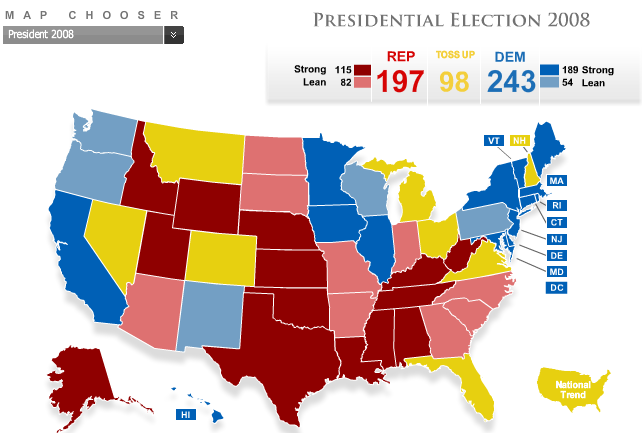
Pollster.com - Electoral Map as of 09-10-2008

I perked up in my seat this morning when reading a blog posting that suggested that the mainstream media (MSM) have been "playing with" the poll numbers to show a bigger bounce for John McCain after the Republican National Convention than for Barack Obama after the Democratic National Convention by altering the party identification (party ID) percentages of the samples. Being one to question these types of things, plezWorld decided to do some research into the matter. Polls, especially national polls, are not an exact science - that's why the numbers can vary over time (everyone doesn't answer the phone, everyone who answers does not agree to participate, some people only have a cell phone, etc.).

I found a terrific NPR audio file that has a very good explanation of polls and polling (I have the embedded file below and the show lasts about 55 minutes). In addition, I found some excellent information at FiveThiryEight that basically lays out the methodology for national polling.

Keep in mind, our president will be elected on a state-by-state basis, so national polls are only a small indicator as to who will win in November. Remember, Al Gore had a substantial popular vote advantage over George Bush, but they ran neck-and-neck in the state-by-state electoral college vote.

What follows are excerpts from blogs that raised the issue and answered the questions about polls.
From Seth Colter Walls at Huffington Post blog:

This week's mainstream coverage of the presidential horse-race has been dominated by a series of polls showing the McCain-Palin ticket with its first stable lead over Obama and Biden. Gallup's tracking poll, USA Today and CBS News all show the Republicans with some kind of lead over the Democratic ticket. But, interestingly, all three polls were also conducted using a higher sampling of Republican voters than in July, raising a question of methodology.

In a year in which Democrats have a lead of 11 million registered voters over Republicans, and have been adding to that advantage through a robust field operation, are pollsters over-sampling Republicans?

Despite a raft of advantages in the electorate for Democrats, in September's first Gallup tracking poll, an equal number of Republicans and Democrats were surveyed (including "leaners") from Sept. 3-5, compared to a 10-point Democratic identification advantage two weeks ago. That partisan makeup of the polling pool resulted in a 5-point lead for McCain in Sept. 5 tracking poll. Meanwhile, the new CBS poll features a 6-point swing in partisan composition toward Republicans, which plays some role in the poll's two-point lead for McCain. Finally, the latest USA Today poll, which claims a four-point edge for McCain, was arrived at after a 10-point swing in partisan makeup toward GOP respondents.

Some polling experts say the changing state of party affiliation in the field is slow to be reflected in polls themselves. Democratic pollster Anna Greenberg told the Huffington Post that "when it comes to registration and turnout, the polls often do a very bad job of taking those [factors] into account," because newly registered voters aren't in the voter files used by firms that survey public opinion. "You could make the argument they are under-representing new registrants," she said, which would mean that the Democrats new edge would not be taken into account.

Monday's USA Today poll had a 48-47 split between Democrats and Republicans surveyed. That represents a nearly 10 point shift in party identification toward Republicans since USA Today's July polling. When asked for comment, USA Today polling editor Jim Norman wrote that "it's possible" that their latest sample includes too many Republicans. Though he added, "it's also possible that we have too many Democrats," because "there's always the chance of an over- or under-representation" in polls.

Still, Norman admitted that the GOP identification in the latest survey has spiked. "The party ID in our most recent poll does show a shift away from what Gallup has been getting in earlier polls, going all the way back to 2005," Norman said. "But previous conventions -- the Republican one in 1988, the Democratic one in 1992, the Democratic one in 2000 -- have also shown shifts in party ID toward the party that had the convention, and those shifts seemed to last, to greater or lesser degrees, though the election. Further, I've been told by Gallup that their tracking poll has shown a similar shift in party ID since the Republican convention. ... I guarantee you we will be watching closely in all of our polls between now and election day to see whether there are further shifts in party ID in either direction."

And it's true. Gallup's own GOP identification (including leaners) has swung six points in the last month, from 42 percent of voters to 48, according to tables provided to the Huffington Post. Meanwhile, solid and leaning Democrats have fallen from 52 to 48 percent of those polled. For political scientists who believe that partisanship is largely stable over time -- and who take note of the advantage in voter registration being experienced by Democrats during the same period -- the newly GOP-heavy poll samples can raise eyebrows.

Emory University political scientist Alan Abramowitz is highly skeptical of the new Gallup, USA Today and CBS polls. About the latter, which showed a statistically insignificant two point lead for McCain, Abramowitz said: "One reason for the dramatic difference between the two recent CBS polls is that the two samples differed fairly dramatically in terms of partisan composition. The first sample was 35.2% Democratic, 26.2 percent Republicans, and 38.6 percent independent. The second sample was 34.9% Democratic, 31.1% Republican, and 34.0% independent. That's a change from a 9 point Democratic advantage to a 3.8 point Democratic advantage. That alone would probably explain about half of the difference in candidate preferences between the two [CBS] polls."


This DailyKos blog posting ran with the information in Huffington Post.

Excerpts from the DailyKos blog:

What about McCain's convention and the Palin factor? Good question. Those events certainly have helped, but McCain was just drawing from a previously depressed group within pre-existant, not additional GOP numbers. Now we need to make it clear. Dems, GOP and Independents can all swing within a specific group (and do, mainly through Independents, with some soft dems, soft repubs though).

Now this is not to say McCain-Palin haven't shown recent movement. They have. Their base (at the moment) seems energized. But the difference is, if party ID was truly representative Obama would still be leading comfortably, or big with most polls, or barely losing or keeping it tight (as he's doing now) with outlier polls like the recent 10 pt USA-Today LV Poll. In other words, when Dem party ID is down, and McCain makes movement, Obama's numbers are not going to appear robust. When party ID is accurately representative (which it rarely is) and there's movement towards Obama, then you get your Bloomberg, Newsweek 13-15 point blowout leads that the media hated. No more of those polls! Lol.

I think the truth or Barack's true representation, lies somewhere in the middle. I think Obama has a natural 5-8% lead out of the 15% Democratic cushion (+11 million out of 73million Dems, Repubs while splitting Indies). You may think his cushion is a little bit more or less (if you feel he has one at all). That's what I think. But if you follow these polls closely, it almost seems they cycle party ID regularly as if on a whim or some periodic schedule.

But my problem is, how come it seems everytime McCain makes a dramatic shift in the polls, it usually follows a good story line (this time Palin and the GOP convention bounce) and is preceded by a perceived inbalanced party ID shift or noticeable increase.

For any potential detractors of this type of article/diary. I would certainly have more faith, if every time a "new Horse Race Poll" came out, it didn't have the chicanery or stench of noticeable, inexplicable party ID shifts attached to/preceding it. Makes sense?

I don't think that's being too disillusioned or partisan.

The moral of the story Kossacks is. Stay strong, volunteer, phone bank, campaign, donate and keep a positive perspective and read through the polls when you can and/or wait for trends, before you get yourself down.

I'm sure the state polls are being done the same way as well (minus a couple of potential outliers, like that North Carolina, SUSA poll).

That's why the Obama Campaign (if you notice) never seems to worry about these sorta things, as much as the breathless press and net-root supporters do. Keep in mind, this is the team (Obama's)that produced the "Obama Spreadsheet". Remember? Despite the myriad swings, soap operas, worry and drama during the democratic primaries, the Obama team pretty much nailed it (state election results & numbers)during the 58 contest. With that kind of success and forecasting under their belt. I'm sure they feel more than equipped to handle, the upcoming 50 state contest on November 4th, as well.

I'm not saying Obama can't lose. He can! We've all discussed the previous bounce models that may end this week or last a month. We'll see and follow this closely of course. Obama also needs to go on the offense (instead continually reacting on defense) and point out all of McCain-Palin's hypocrisies and lies.

Now Sarah Palin; regardless of what we think of her, is the latest media darling. Is there real substance there; probably not. Is she going to do a revealing, potentially game changing interview, who knows? Is the finally media going to do their job (despite McCain campaign threats to the contrary) and expose/vet this womans wafer thin record, credentials and scary positions? Who really knows. Geraldine Ferraro started out like Hot Cakes in 1984 for about a month or so, but her and Mondale's campaign imploded due to repeated scandal and gaffes(sound familiar?)

Don't forget; Democrats have all the structural advantages that laid the smart money on Obama in the first place(you know bad economy, bad incumbent President, negative job loss, etc.. That's all still there. I don't want to jinx Obama, but a little known fact is, that no incumbent party in history has every won the Presidency with all those negative factors against it/present (I know "knock on hard wood twice).

Make no mistake. It will be a fight, with the usual ups and downs and suprising trials and tribulations. But Obama should win (and it may be in the long run a convincing win). Once your in the middle of the storm you can never look ahead and see the clear blue skies. But they will come again (they always do). We will withstand this current storm. So let's take it all in perspective and continue to Press the media for fairness and Obama for toughness. It's too early to toss out the white flag for this fearless, beloved, 1st time black candidate.

I dont' want to hear no more metaphors of:

"The Sky Is Falling, because Obama and our election are calling!"

Okay!


This next blog posting goes a long way to explaining the methodology used by the national polling services. And it explains why some of the party ID percentages may change over time.

From Nate Silver at FiveThirtyEightblog writes on polling methodology:

So let's get a few things straight:

1. Polls that show changes in party ID composition are not "cooked", "rigged", or "biased". Changes in party ID composition may occur for a variety of reasons, including random chance, response bias, temporary changes in party affiliation, and longer-term changes in party affiliation. It is possible that, if the partisan ID composition of a poll shifts rapidly from week to week (more so than is likely from random chance alone, and more so than is precipitated from external events), this may be an indictment of a pollster's methodology -- that the pollster is having difficulty getting a good, random sample. But the notion that credible pollsters like Gallup or SurveyUSA are deliberately rigging their samples is patently ridiculous. Polling is a very competitive industry, with relatively low barriers to entry; they would go out of business in a hurry if they did this.

2. The decision a pollster faces is whether or not to weight its sample by party ID. In fact, the whole point is that pollsters like Gallup and SurveyUSA do not weight their samples by party ID -- they just tally the results, and let the chips fall where they may. So in some sense accusing them of "cooking" their samples has it backward; what you're really arguing is that they should weight their samples, presumably in a way that is more favorable to your preferred candidate.

However, there is no one right answer as to whether to weight by party ID is the superior choice. A couple of pollsters, notably Rasmussen, do weight their samples by party ID. These pollsters tend to get more stable results from week to week. However, more stable does not necessarily mean more accurate over the long run, as these pollsters may miss real changes in party ID that occur over time.

Rasmussen, which targets its party ID figures based on a rolling, three-month sample of interviews with thousands and thousands of voters, has what I consider to be a eminently reasonable approach. Even so, the true party ID composition of the electorate is difficult and perhaps impossible to ascertain. You can take a survey of party ID, but it is still a survey, and therefore itself may be subject to issues like poor methodology and response bias.

There might be some promise in targeting party ID figures based on actual changes in voter registration -- although many states have open (non-partisan) voter registration, and some of those that do require registration by party do not report these figures. Some state-level pollsters seem to flirt with this approach, although I do not believe that any of the more prolific, national pollsters do.

3. Changes in party affiliation are tied up in the notion of the "convention bounce". Successful party conventions usually produce some shift in the self-reported partisan composition of surveys taken in the days and weeks that follow them. This may be a form of response bias, if voters of a particular partisan persuasion are fired up by their convention and more likely to take a pollster's phone call. (It may particularly be a form of response bias if the poll is taken during the convention itself, as voters of a particular party may be more likely to be at home watching their party's convention, and therefore more available to take a phone call).

However, remember what the conventions are. They are the Republican National Convention and the Democratic National Convention -- not the McCain National Convention and the Obama National Convention. They are big advertisements for the parties themselves. And so, it is not unlikely that, if voters respond favorably to a convention, they will respond favorably both to the candidate and to the candidate's party.

In other words, while some of these polls may have implausibly high numbers of self-reported Republicans in their samples, this is more a symptom of the convention bounce rather than a separate and distinct phenomenon. Moreover, conventions sometimes do trigger longer-term shifts in party identification. In 2004, for instance, the Republican convention appeared to cause a semi-permanent shift in party ID toward the Republicans, amounting to a couple of points. As I also argued recently, it is also plausible that unenthusiastic Republicans or Republican-leaning independents (which I call "shy Tories") were being undersampled prior to the Republican convention, until the convention renewed their enthusiasm.

The fact that the Bush administration is in its last days, that much of the dissatisfaction with the Republican Party had to do with George W. Bush, and that this is an election featuring two non-incumbents, is a salient factor here. It may be that, rather than trying to tie John McCain to George W. Bush, the Democrats should be making more of an effort to indict the Republican Party as a whole, of which John McCain is indisputably a member.

4. Responsible pollsters should always disclose the partisan ID composition of their samples, and should notate in their press releases when material shifts occur. Regardless of the above, there is little doubt that the partisan ID composition of a poll is an extremely important element in the proper interpretation of a poll. Pollsters should always report the partisan ID composition of their sample, and should qualify in their write-ups when substantial changes in party ID have occurred since their last survey.

-- Nate Silver at 9:48 AM


Charles H. Franklin does an excellent job of explaining how polling works and answers questions about the efficacy of the polling science. He even addresses a question on the Bradley Effect.

Political Arithmetik's Charles H. Franklin, a professor of political science at the University of Wisconsin, where he teaches statistical analysis of polls, public opinion and election results was on NPR on Wednesday. Listen here.


Read the full blog posting at Huffington Post here.

Read the full blog posting at DailyKos here.

Read the full blog posting at FiveThirtyEight here.

Read Time.com article on CNN/Time poll here.

plez sez: polls schmolls!

i'm not swayed by the polls, but there is no doubt that there is small population that may be swayed by them. what is disturbing is that the media probably uses skewed data to make a particular race seem closer in order to keep viewers engaged in the race. this year, the race in and of itself is compelling enough (first Black presidential candidate, war hero candidate, first republican woman candidate, etc.) without the questionable numbers that are bandied about on a nightly basis.

i don't feel better about polling methods, BUT i know now that i will tend to pay LESS attention to poll results (since they are so fluid, the margin of error is probably considerable higher than advertised, and the sample may not be representative of the voting population).