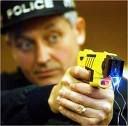
Over the past couple of years, there has been a growing epidemic of taser-related deaths at the hands of the police. Unfortunately, an unsettling number of these deaths are Black men. As peace officers, the job of the police is to maintain order and enforce laws. Using their police powers to indict, convict, and execute innocent Americans has never been part of their job description. The only time that deadly force should be used is when their lives or the safety of the general public is threatened.
The taser is supposed to be a non-lethal way to subdue and apprehend those suspected by the police of crime or mayhem. Unfortunately, this tool has become as lethal as a bullet fired from an officer's service revolver.
CNN.com reports that Amnesty International has reported that, since June 2001, more than 150 people have died in the United States after being subdued with a stun gun. The organization has called for police departments to suspend use of the devices pending study of their possible risks. Few have done so, said Amnesty, which added that more than 7,000 of the nation's 18,000 law enforcement agencies use the devices.
Back in July 2008, plezWorld posted the sad story of Baron "Scooter" Pikes who was executed by the police after he was tasered NINE TIMES.
After wandering over to Electronic Village, you will notice that Scooter's sad story is far from being out of the ordinary:
plez sez: i am a proponent of the actions necessary to review the use of tasers. if they are no longer a non-lethal alternative, then maybe they should be banned.
it is my hope that by bringing this story to plezWorld on this day of blogging for justice, the injustice caused by the unlawful use of tasers by the nation's police will be addressed.
the UN has condemned the use of tasers as torture. in light of the ongoing discussion about the Bush policies of torturing prisoners of war, we have verifiable examples of US citizens being tortured to death by the very police who had sworn to protect them.
In November 2006, a group of Atlanta police officers executed a "no knock" warrant at the home of Kathryn Johnston in a drug infested part of Atlanta. Thinking someone was breaking in, 92-year old Johnston squeezed off a warning shot from the old pistol she kept by her side. The police officers burst in behind a hail of gunfire, leaving the elderly woman riddled with bullets in her own home.
The police officers planted some marijuana in the house and "lamented" the old lady's loss of life while trying to protect her "drug empire"! Yeah, a 92-year old drug dealer!
Well, two and a half years later, the cops who perpetrated the crime are finally brought to justice.
Excerpts from AJC.com story:
A federal judge who sent three fallen cops to prison for a notorious drug raid that left an elderly woman dead said Tuesday that Atlanta Police Department performance quotas unduly influenced the officers’ behavior.
At the close of an emotional two-day hearing, Carnes sentenced former officers Gregg Junnier, Jason R. Smith and Arthur Bruce Tesler to between 5 and 10 years in prison.
At the hearing, Tesler’s lawyer provided examples of other Atlanta police officers breaking the rules or violating the law and said a disturbing culture of misconduct pervades the force.
Carnes imposed the most severe sentence — 10 years — on Smith, 36, who obtained the illegal, no-knock search warrant allowing officers to batter down 92-year-old Kathryn Johnston’s door.
A terrified Johnston, thinking she was victimized by a home invasion, fired a warning shot through the door. Narcotics officers responded with a hail of gunfire, killing her.
Carnes sentenced Junnier, 42, to 6 years in prison. Junnier, the most experienced officer, was the first to cross the “blue line” — the unspoken code of silence among police — and divulge to the FBI what really happened at Neal Street and how the officers concocted a sophisticated coverup.
For Junnier’s cooperation, Carnes cut his time from the 10 years recommended by sentencing guidelines.
The judge gave the biggest break to Tesler, saying prosecutors’ recommendation of a 10- to 14-year term was “unduly harsh” because, overall, he played a “minor role.” She sentenced Tesler, 42, to five years in prison.
The FBI also found performance quotas of 9 arrests and 2 search warrants a month expected of officers, McKenney said. Officers who failed to meet their quotas risked being transferred, he said.
This helped explain, Carnes said, why Smith, Junnier and Tesler — three men who were devoted family men and who gave selflessly to the communities — began cutting corners through lies.
Carnes also ordered all three former officers to reimburse Johnston’s estate the $8,180 it cost to bury the 92-year-old woman.
~ ~ ~
plez sez: but will there ever be justice for Kathryn Johnston? she's still dead. it may be years before the family sees the $8,000 for her funeral costs. what ever became of her house?
this is one of those stories that have no happy endings. these cops will do some time, but nothing equal to first degree murder during the commission of a crime. ms. johnston's family will never be adequately compensated for their loss. and i'll bet my paycheck that to this day, drug dealers are still slinging crack down the street or around the corner from where ms. johnston was slain.
The world turns its attention away the extended play version of American presidential politics and focuses attention for the next fortnight on Beijing, China, first time host of the Olympic Summer Games.
China's 1.25 billion people will welcome over ten thousand Olympians, along with hundreds of thousands of fans, and 30,000 journalists. All are being watched over by a 100,000 member security force, which means that uniformed and plain-clothes operatives will outnumber the 10,500 athletes by nearly nine to one. In Beijing, heavily armed police roam the airport. Subway passengers must submit to bag checks and go through X-ray machines. The Beijing National Stadium, site of the opening ceremony, is protected by anti-aircraft guns.
Terrorism worries the Chinese government the most. State media reported in July that the anti-terrorism force was placed on high alert.
Both Interpol and the U.S. State Department have said there is cause for concern, especially over Muslim extremists with possible links to al Qaeda.
Earlier this year, Chinese officials said they stopped a plot to bomb Beijing and Shanghai and to poison the water supply during the Olympics. In March, a flight crew allegedly prevented a hijacking. Muslim separatists from the restive Xianjiang region were blamed both times.
When Beijing was awarded the Olympics, the Olympic Committee urged the country to take a long, hard look at its countless human rights violations... and make efforts to fix them. To date, there has been little movement in that area.
Human rights violations appear to be a way of life in China. Several sources point to numerous policies that remain in effect
Controls on Expressions and Associations Restrictions on Independent Organizing: Although the Chinese Constitution guarantees freedom of association and assembly, national regulations severely limit association and give the authorities absolute discretion to deny applications for public gatherings or demonstrations. In practice, only organizations that are approved by the authorities are permitted to exist, and any organization that is not registered is considered "illegal." Restrictions on Free Speech and the Media: Although the PRC's 1982 Constitution guarantees citizens freedom of expression and of the press, its preamble mandates adherence to "four basic principles"-- the CCP's leadership, socialism, dictatorship of the proletariat and Marxism-Leninism Mao Zedong Thought Suppression of Religious Freedom: The PRC prohibits all religious activities outside establishments registered under the official branches of four state-recognized religions (Buddhism, Taoism, Christianity and Islam), established by the PRC government during the 1950s, through which Chinese and Tibetan religious adherents are required to practice their faith.
Torture and Ill-Treatment of Prisoners Torture of detainees is endemic in Chinese detention centers and prisons. Although China became party to the UN Convention Against Torture in 1988, the government has not taken effective measures to diminish the risk of prisoners being tortured or ill-treated
Lack of Judicial Independance and Due Process Arbitrary Detention: In addition to judicial convictions, PRC authorities consistently use administrative procedures to detain hundreds of thousands of Chinese and Tibetans each year. Conditional Releases with Continued Deprivation of Rights: The PRC infrequently has released political prisoners of conscience before the completion of their sentences, predominantly as a result of international pressure
Death Penalty Death sentences have been imposed based on forced confessions and are often decided in advance of the trial by "adjudication committees," thereby circumventing defendants' rights to a fair and public hearing and presumption of innocence
Add to these policies, it is rumored that Chinese officials have asked Beijing area merchants to discriminate against certain Olympic athletes.
Asia News reports:
...that for "reasons of safety", bars are forbidden to serve "blacks" and Mongolians or place tables in the street. Street musicians are being banned, and so is buying medicines containing "stimulants" without a prescription. Prohibitions are on the rise for the Olympic capital, while the first leaks reveal a grandiose fireworks display for the inauguration.
Bar owners around the Workers' Stadium in downtown Beijing say that public security officials are telling them not to let in "blacks" and Mongolians, and many of them have even had to sign a pledge. The official reason is the fight against drugs and prostitution, dominated in the past by Mongolians and persons of colour. Moreover, public places must close by 2 a.m., for security reasons, and the bar owners are being asked to remind their clients that they must always have an identification document with them. There is even doubt over whether the bars within a radius of two kilometres from the Olympic buildings will be able operate, or whether they will have to shut down for the entire period. In some areas, tables are not permitted outside, because "the presence of too many foreigners gathered outside could create problems". There is also an attempt to shut down outdoor musical concerts, to prevent disorder.
Jazz musician David Mitchell says that it is increasingly difficult for his band to find places to play in Beijing "Everything is aimed at creating stability, but they don't understand that is precisely the unfounded prejudice that foreigners have of Chinese society - that it is a highly controlled and not a very cultural place. It seems completely self-defeating".
To guarantee a "clean" Olympics, a doctor's prescription is now required for 1,993 commonly used medicines, or the package must show a warning that the product contains substances believed to be stimulating and not permitted for the athletes. One must go to a hospital to get a prescription, but many of the hospitals ask for as much as 100 yuan for each prescription, causing problems for the elderly and the poor most of all.
The Huffington Post reports a similar "no Blacks and Mongolians admitted" story with a slight wrinkle:
Hong Kong's English newspaper The South China Morning Post reported Friday that Chinese authorities have issued a secret ban on blacks, Mongolians and other "social undesirables" from Beijing's bars during the Olympics.
As the content on South China Morning Post's site is for subscribers only, here is an excerpt of the article c/o the Beijing drinking blog Beijing Boyce:
Beijing authorities are secretly planning to ban black people and others it considers social undesirables from entering the city's bars during the Olympic Games, a move that would contradict the official slogan, "One World, One Dream".
Bar owners near the Workers' Stadium in central Beijing say they have been forced by Public Security Bureau officials to sign pledges agreeing not to let black people enter their premises....
Security officials are targeting Sanlitun, which Olympic organisers expect to be a key destination for foreign tourists looking for a party during the Games.
The pledges that Sanlitun bar owners had been instructed to sign agreed to stop a variety of activities in their establishments, including dancing and serving customers with black skin, they said.
China's preeminent English-language media analysis site Danwei didn't lend credence to the SMCP report, calling the high-level ban "unlikely." However Jeremy Goldkorn writes on Danwei that "it is highly plausible that some low level cops have issued such instructions, especially with the current state of high alert in Beijing making officials and government agencies paranoid and very nervous about foreigners."
Further investigation by Beijing Boyce, who interviewed Beijing bar owners on the alleged ban, found that low-level Beijing cops have been visiting the capital city's watering holes and warning owners and employees to keep their eye on black patrons. According to an update Saturday on Beijing Boyce:
An owner said police met with Sanlitun bar reps and told them to monitor black patrons. He said the police told the reps that drug dealers are predominantly black in the area. He said the police did not ask bar owners to ban blacks.
In response to the mounting anger over Beijing's hosting the Olympics, President George W. Bush will "chide" the Chinese for their behavior from his perch at the Beijing Olympics. Hours before arriving in Beijing Thursday, U.S. President George W. Bush will express his "firm opposition" to human rights violations in China.
In a speech to be delivered Thursday in Bangkok, Thailand, Bush will denounce the detention of political dissidents and religious activists - a stinging criticism of Chinese leadership on the eve of Friday's opening of the Olympics, and one that is bound to anger his Chinese hosts.
Chinese communists leaders already have been heavily criticized for their crackdown on dissent in the weeks leading up to the Beijing games, and have bristled at Bush's earlier musings about using his trip to raise human rights.
"I have spoken clearly, candidly, and consistently with China's leaders about our deep concerns over religious freedom and human rights. And I have met repeatedly with Chinese dissidents and religious believers," says Bush's prepared text.
"America stands in firm opposition to China's detention of political dissidents, human rights advocates, and religious activists. We speak out for a free press, freedom of assembly and labour rights, not to antagonize China's leaders, but because trusting its people with greater freedom is the only way for China to develop its full potential."
Read CNN.com articles on the Beijing Olympics here and here.
Read a fact sheet about China's human rights abuses here.
Read about Beijing's planned banning of Black patrons here and here.
plez sez: think hard. real hard. when was the last time the government of china gave a FLIP about what the rest of the world thought?
as long as we're kept knee deep in cheap sweatshop labor produced goods from china, who's to say that they can't run their government and mistreat their people with impunity. hey... how can 1.25 billion (20 percent of the worlds population) be wrong?!?
the olympic selection committee got it ALL wrong when they decided to pour trillions of dollars into the growing chinese economy by giving them the 2008 Olympics! to HELL with the people of Tibet, who cares about the people starving to death in Darfur, who cares about the dissidents who have conveniently grown quiet over the past couple of months in china? who cares that china thinks that Blacks and Mongolians pose such a threat to their way of life that they aren't allowed in beijing's bars during the Olympics? who cares that george w. bush is going to give some mealy-mouthed speech about human rights (in light of the fact that just five years ago the US invaded a sovereign nation for no reason)?
to top it off, make no mistake... the chinese athletes are going to garner the lion's share of gold and silver medals over the next two weeks. have you ever tasted chinese home cooking?!? well, you're gonna see how it tastes when the FIX is in! imagine the Olympic NBA Stars getting beat by the China National team... and don't be surprised to see Yao Ming wearing his Olympic gold medal for basketball when he's back in houston next season while rapping on YouTube, "Hey Kobe! Tell me how my ass taste!"
A few days ago was "Blog for Justice Day" in the AfroSpear; ever so often a group of Black bloggers will take up a cause and blog about it on a specific day. This week's Cause Celeb had to deal with the rash of deaths of Black men at the hands of police officers wielding Tasers. plezWorld happened to beat the rush by blogging about the Baron "Scooter" Pikes Taser Death a few days earlier.
While perusing the member sites, I came across a blog entry that was well-written, hard hitting, introspective... and just too damn good to pass up! After requesting and receiving permission from The Republic of T., I am pleased to present the latest in the long line a guest bloggers in plezWorld.
Held Suspect By Terrance of The Republic of T. July 31, 2008
I don’t remember how old I was the first time it happened. I couldn’t have been more than ten years old. We were in Philadelphia — my mother, my younger sister, and I — visiting my great grandfather on my mother’s side of the family. For my sister and me, it was our first time traveling that far from home, and our first time in a city like Philadelphia. Everything amazed us, from the size of the buildings, downtown to the narrow little houses on my great great-grandfather’s street, with no yards to speak of and no space between them; so different from our suburban home back in Augusta, GA.
Even going shopping was different. Instead of driving to the store, my mom pushed her grandfather’s folding cart a few blocks to a store a few blocks away, and we followed her. The store was a wonder unto itself; on the outside a rowhouse like the one my great grandfather lived in, but on the inside there were long, narrow shelves holding food, toys, and other items we’d never seen before.
Our mother had told us time and time again not to touch anything whenever we went shopping, but we couldn’t help it this time. We picked up toys and candy and other items, exclaiming to each other to “come look at this.” Until it happened.
I heard the shopkeeper before I saw her.
“Put that back!” a female voice shouted. “What are you doing in here?! You better not take anything, ’cause I’m watching you.” I looked up and into the anger-twisted face of a large, angry white woman.
We too much in shock and too frightened to say anything. I don’t remember what else she said, but I’m pretty sure she called us theives and threatened to call the police. I looked around for out mother, who hadn’t realized that we were no longer behind her. I didn’t see her for a moment, and then she appeared, no doubt drawn back to the front of the store by the commotion. She flashed us a look, and apologized to the shopkeeper (who was still giving us an angry look as we left the store with our purchases). It wasn’t until we ere out of the store that our mother explained.
The shopkeeper thought that we were stealing from her store. We didn’t understand until mom made it clear: the shopkeeper assumed because we were two black children we were going to steal from her store, and that’s why she treated us like criminals.
It was a lesson I never forgot, and one that’s been repeated throughout my life. I thought about that first time when I read this article from CNN’s Black in America series, about how being black automatically means being suspect.
For Anthony Williams, being black in America means being a suspect.
The 39-year-old former Marine said he’s never had any trouble with the law, other than a few traffic violations, and leads a middle-class life in the Atlanta, Georgia, area.
But the AT&T customer care representative said he still gets nervous when he hears that police are looking for a 6-foot-tall black man, “because I know I fit that description.”
“I worry I will get pulled over and some police officer decides to shoot first and ask questions later,” Williams wrote.
Police recently questioned him in his own driveway after getting complaints that a man was walking in neighbors’ yards, Williams said. iReport.com: Tell us what you thought of “Black in America.”
“You never know what to expect when you get pulled over by police, and that’s how it is when you’re black,” he said.
ii
I fit the description then, and I’ve fit the description since. The next time I can remember is when I was in college. I was walking back from class, on my way to the dining hall for dinner, dressed like most of my friends dressed on our predominantly white campus, in torn jean and a t-shirt. I was halfway across the parking lot of one of residence halls when it happened.
I’d seen the police car when I was waiting to cross the street. I didn’t give it much thought, because I wasn’t doing anything. But the officers had paid a lot more attention to me than I had to them. They turned into the parking lot, and stopped right in front of me as I walked across.
One of the officers got out of the car and began asking me questions. Was I a student? Where was I going? Where was I coming from? Could I show him my student I.D.? I did, and he told me that there had been some cars broken into in that lot, and some break-ins at the nearby dorms, and that I fit the description of someone seen in the area around the time of the earlier crimes. And then more questions. Did I know anything about the robberies? Did I know who might be responsible? Did I walk through that lot every day? (Not after that day, I didn’t.)
Eventually, the officer finished his questions and let me walk away. They sat parked in the car as I went on. Keeping an eye on me, I’m sure. I thought about how differently that situation might have ended, because I knew even then the truth in what Anthony Williams said: “You never know what to expect when you get pulled over by the police, and that’s how it is when you’re black.” This was before the Amadou Diallo shooting, before Malice Green, and before Abner Louima. But being from the south, I heard stories, and I knew that I couldn’t completely trust the police, even if I’d done nothing wrong; not so much because of the police a whole, but because I didn’t know who — what kind of person — was behind the uniform, and what they might project upon me as a black man. I’d been trained without even know it on how to respond to the police; saying “Yes, officer,” and “No, officer,” and offering only the information that was requested, and then only if they had a right to ask for it and I didn’t have a right refuse. Ask the questions I had a right to ask, but never show anger or disrespect, even if they do.
iii
I knew even though it was years before my father tried to tell me what law enforcement might both projected upon me and then respond to whether I reflected it back to them or not.
I was in college at the time. I’d been home for a weekend visit, and was heading back to school — at the University of Georgia, in Athens, GA. As I made several trips back and forth, loading up the car, my dad sat on the couch, watching television. Out of the corner of my eye, I thought I caught my dad looking at me with what appeared to be concern, as though he was trying to decide whether to say something to me about it.
Finally, I finished loading the car, and said my goodbyes. But my dad stopped me before I could make it out the door and finally spoke his concern.
“Son,” he asked, “is that what you’re wearing to drive back to Athens?”
I was wearing my basic school “uniform” at that time: a ripped pair of old, faded jeans, and a old t-shirt.
“Um, yeah,” I said.
My dad then breathed a sigh that seemed a mix of resignation, exasperation, and trepidation over what he was about to tell me — what he had to tell me, really.
“Son,” he said, “You are going to be driving through a lot of southern counties. Now, I’m not saying you’re going to do anything wrong. But you are a young black man, and if you get pulled over by one of these southern sheriffs or policemen, they are going to take one look at you and get the wrong idea. They’re not going to treat you like they would a white boy dressed like that.”
It was on the tip of my tongue to argue with him, and say that stuff like that may have happened when he was my age, but it certainly didn’t happen anymore. Instead, I unpacked some clothes, and changed into a pair of khakis and a buttoned-down oxford, which met with dad’s approval.
I was still thinking about my dad’s words when I got back to UGA. After unloading the car and carrying everything up to my room, I turned on the television. At some point, the news came on and I saw this.
“This” was the Rodney King beating.
Since then there has been Sean Bell. There has been Kathryn Johnston. There has been Robert Davis.
There has been Jessie Lee Williams. There has been Albert Mosley. There has been Anthony Carty. There has been the Jena Six.There have been many.
And now, half a year after his death, there is Baron Pikes.
Baron “Scooter” Pikes, a 21-year-old sawmill worker, had tried to run from police in Winnfield, Louisiana, when they tried to arrest him on an outstanding warrant for cocaine possession.
But a coroner’s report found Pikes had been handcuffed and on the ground when first hit with the Taser and might have been dead before the last two shocks from the 50,000-volt device were delivered.
...In the year since Winnfield police received Tasers, officers have used them 14 times, according to police records — with 12 of the instances involving black suspects. Ten of the 14 incidents involved Nugent, who had no public disciplinary record.
Police said Pikes told officers he suffered from asthma and had been using PCP and crack cocaine.
But Dr. Randolph Williams, the Winn Parish medical examiner, said he found no sign of drug use in the autopsy and no record of asthma in Pikes’ medical history.
And for every Baron Pikes there are hundreds, even thousand of men like Michael Tillman.
Michael Tillman was 20, with a 3-year-old daughter and an infant son, when he was brought into the Area 2 police station on Chicago’s South Side for questioning. His mother, Jean Tillman, says that although he had gotten into some trouble with the law as a youngster, he had been on the straight-and-narrow, working as a janitor and paying his bills, since he and his girlfriend had their first child. That was July 22, 1986.
He hasn’t been home since.
Tillman is one of at least 24 African-American men that the People’s Law Office in Chicago claims are still serving sentences for crimes they say they confessed to only after enduring hours of torture at the hands of Chicago police officers under Commander Jon Burge between 1972 and 1992. Although 10 of Burge’s victims have been pardoned or given new trials after their illegally obtained confessions were exposed, the vast majority of the 100-plus cases have yet to be reviewed by the state of Illinois. Those men have either served out their sentences, died in custody or, like Tillman, continue to live their lives behind bars, hoping that one day they will have a fair trial.
According to Tillman’s 1986 trial testimony, when he arrived at the Area 2 police station in the predawn hours of July 21, 1986, Detectives Ronald Boffo and Peter Dignan took him to a second-floor interrogation room and pressed him for information about the murder of 42-year-old Betty Howard, whose body was found the day prior in the apartment building Tillman oversaw. When he told the detectives that he knew nothing about the murder, he says that Boffo and Dignan, along with three other officers, became abusive. Without ever reading him his Miranda rights, he says they handcuffed him to the wall, hit him in the face and punched him in the stomach until he vomited blood. During the course of what appeared to be three days, rotating pairs of officers brought him to the railroad tracks behind the station and held a gun to his head, suffocated him repeatedly with thick plastic bags, poured soda up his nose and forced him into Dumpsters outside of the apartment building, ordering him to search through the rubbish for a murder weapon until, according to Detective John Yucaitis, Tillman confessed to the crime.
According to Tillman’s mother, she, her husband and an attorney they called for counsel were all denied access to her son during his three days of interrogation.
There will be more.
How can there not be? A black man reporting on crime is held suspect.
THE police officer had not asked my name or my business before grabbing my wrists, jerking my hands high behind my back and slamming my head into the hood of his cruiser.
“You have no right to put your hands on me!” I shouted lamely.
“This is a high-crime area,” said the officer as he expertly handcuffed me. “You were loitering. We have ordinances against loitering.”
Last month, while talking to a group of young black men standing on a sidewalk in Salisbury, N.C., about harsh antigang law enforcement tactics some states are using, I had discovered the main challenge to such measures: the police have great difficulty determining who is, and who is not, a gangster.
My reporting, however, was going well. I had gone to Salisbury to find someone who had firsthand experience with North Carolina’s tough antigang stance, and I had found that someone: me.
A black woman with a big purse can’t even go shopping. (Or, to quote EnVogue, “can’t look without being watched.”)
About ten minutes into my search for the perfect boot my sister comes to me and says that she has to go to the restroom. I told her okay and that I’d watch Erica. By then I had zoned in on a pair of 9 ½ red Kenneth Cole boots and was searching for an employee to get the left shoe so I could try them both on. I told Erica that “Big TT” needed her fashion advice while “Little TT” handled her business.
So while Erica and I weighing the pros and cons of the red Kenneth Cole boot my sister comes running up to me looking both very frantic, frustrated, and upset. She says that we need to go and that I shouldn’t spend my money here.
Now my sister Jorjanna is the sweetest person, aside from my Grandmother that I know, maybe almost to a fault. She’s always cheerful and happy, yeah, nothing like her big sister, lol. So for me to see her so upset I wanted to know why.
She said that she didn’t think anything of it at first but that when we separated and were looking at shoes on our own, that she was asked more than four times by various employees if she needed help, to which she politely replied no. However, when she went to the back of the store to use the public restroom, one of the employees came in after her and my sister overheard the tail end of a conversation on a walkie-talking wherein the employee said “Who? The Black girl that just went into the restroom,” before realizing that my sister heard her. When my sister finished in the restroom, she came out and realized that she forgot to put on her lipgloss and as she reached in her purse and turned around to go back into the restroom the same employee who just asked if she needed any help accosted her yet again. By then, my sister said she got it and she quickly made her way back to where my niece and I were.
While my sister is telling me what happened three of the employees were standing a few feet away watching her. This angered her and so my sister said, “Yeah, I’m talking about you.”
To media figures like Ann Coulter, Toby Keith and Bill O’Reilly, even lynching is a joke. And for all of the above and more, cotton-picking black folks should be grateful.
Meanwhile, the KKK distributes fliers in Virginia, claiming residents requested information; students at a New Jersey middle school are assigned a project defending slavery; the vice president relaxes at a hunting lodge that flies the confederate battle flag; nooses start appearing at various college campuses, and even re-appear in Jena, LA, and the discussion ends up being about whether hanging nooses is just a prank; an all-white panel of journalists debates whether Barrack Obama is black enough.
Is it any wonder that racism literally makes us sick? (And when it does, we get substandard treatment?)
iv
Years after that conversation with my dad, I was held suspect again, in another police encounter that could easily have gone south.
Several years later, I was living in Washington, D.C., and found myself driving home late one night. I was giving a fraternity brother of mine, also a black male, a ride home after a late night fraternity event. My car wasn’t in the greatest shape. I’d been in a traffic accident just a few days before, and hadn’t taken it to be repaired because I needed to drive it that weekend.
We were driving past the Capitol when we got pulled over. I saw the flashing lights, and as soon as I heard the siren I pulled over. By then, I knew the drill. Don’t argue with the officers. Don’t get out of the car unless they tell you to. Get out of the car if they tell you to. Answer any questions with “Yes, officer,” or “No, officer,” give them any information they ask for, and maybe — just maybe — you won’t have any trouble. Still, what happened then was a bit surreal.
As the officer came up to my window, I said a silent prayer that my fraternity brother — Neal, who was known for having a sharp tongue and a willingness let it loose — would keep cool. The officer asked for my license and registration. She asked if I knew why she stopped me, and I said no. She said it was because one of my tail lights wasn’t working, and agreed with me when I said it was probably a result of the accident I had a few days earlier. She seemed to believe me when I told her I didn’t know about the tail light.
I thought maybe she’d give me a ticket or a warning, and give my documents back to me. Instead, she walked back to her car and got on her radio. I wasn’t worried, because it wasn’t like I had an outstanding warrant or anything more than a couple of unpaid parking tickets. But while she was in her car, another police car pulled up, and two more officers got out.
In my rear view mirror, I saw the officer who stopped us get back out of her car, at the same time that I saw yet another police car pull up. At this point, I started to get nervous — after all there we were, two black males, driving through D.C. at 4 a.m., in a banged up car, with the police units and six police officers now at the scene. Depending on any number of factors, including what we said or did, it might not matter if we’d done anything wrong.
“Is this your vehicle?” the officer asked me when she arrived back at my window. “We’ve had some car thefts reported in this area.”
I assured her that it was my car, and she stepped away for a moment to confer with one of the other officers now milling about the scene. At that moment, a police van showed up, and stopped alongside the passenger side of the car. Neal, who hadn’t said a word up to this point, looked at the van, looked at me and just said “What the…”
I finished his sentence silently, in my mind.
The officer, at this point, was back at my window. “Sir,” she asked me, “do you have the title to the vehicle.”
How many people keep the title to their car in the car itself? I didn’t know, but I knew that I did have the title in the car. I knew just where it was. It was in my briefcase, which was in the trunk of the car. I knew that in order to retrieve the title, I’d have to get out of the car — and with at least eight officers now pretty much surrounding us — walk over to the back of the car, open the trunk, open the briefcase, and retrieve the title.
What if, I thought, just one of these officers thought I was reaching for a gun at any point in that series of steps? That I had no gun — had never even owned one, in fact — was and would have been meaningless in that moment. It wouldn’t have mattered.
...I told the officer that I had the title, and that it was in my briefcase, in the trunk of the car. I told her I’d have to get out of the car, open the trunk, and open the briefcase to get the title out and show it to her. She gave me the go ahead, and I walked around to the back of the car, opened the trunk, opened the briefcase, and got the title. I don’t remember if the officer followed me, and I didn’t look to see if any of the officers had their hands on their weapons. I couldn’t.
I showed the officer the title. She looked it over, handed it back to me, and told me to get back in the car. The van drove away, and one of other police cars drove away. Finally, the officer came back to my window.
“I’m giving you a warning,” she said. “You take him home, get yourself home, and then I don’t want to see you driving this car again in this condition.”
I assured her that she wouldn’t.
“Alright,” she said. “Have a good one.”
I rolled up my window, and started the engine. To this day, I am eternally grateful that Neal waited until the windows were rolled up and we were driving away from the police officers to exclaim — well out of their earshot — “Have a good one? F___ you!”
I laughed, out of sheer relief, but I understood that there was a moment back there when we could have been “another Rodney King.” We could have been “another Malice Green.” We could have been Amadou Diallo, or even Abner Louima.
v
Almost thirty years after that trip to Philadelphia, and my first experience of being held suspect because of my race, I am a father to two sons, who will grow up to be black men in the same world that I did; a world that has changed very much, and very little since then. The youngest is seven months, and it will be a few years before he knows anything about the notion of — or the implications of — race. My oldest on the other hand, is five (or five-and-three-quarters, as he tells anyone who asks), and the day is approaching faster than I’d like to think when I will have to find a way to tell him what I’ve experience, in a way that may help him avoid some of what I’ve experience, but that doesn’t chip away the confidence that makes me smile with a fatherly pride I understand better now than I did when I saw the same in my dad.
Part of me must learn to see them — however much it pains me — not with a father’s eyes, but as my father saw me in that moment before I drove back to school, with the eyes of the rest of the world. It’s necessary, in order to spare them pain, to somehow let them know that there are people in the world who will not see them as I see them. There are people who will see them and not see their intelligence, the loving home and family they came from, their potential or their personhood. There are people who will project upon them what they believe about black men, and about black people, and respond to that even if that’s not who my sons are, even though I will teach them that they do not need to reflect back all that’s projected upon them. And some of those people will be in uniform.
I will have to teach them something else that my parents taught me, which Michael Eric Dyson articulated commentary written for the CNN series, about himself and his brother.
And he is not alone. There are thousands of black men who are rotting in jail cells who have done nothing to merit incarceration. And even when they get in trouble, a great number of black men go to prison for nonviolent drug offenses. Often, crippling racial profiling and suspicion of black men put them on a path to prison, while white males who commit similar offenses are arrested and convicted in far smaller numbers.
The point is not affirmative action for black thugs. The point is that white males often get second, third and fourth chances for reform — either because they weren’t suspected to begin with, or they are given far lighter sentences and far more favorable treatment — while black males are severely punished for even relatively small infractions.
Even though I grew up in an integrated neighborhood, went to an integrated school, my parents made sure I understood that I couldn’t do everything some of my friends might do, and expect the same treatment if I got into trouble. It’s a knowledge that probably kept me out of trouble, because it made me think twice about going along on what might be considered a “youthful prank” for my friends, but would be treated much differently in my case.
In college, I had a white roommate who had what you might call an “all-American” look (which meant, and often still means white, preferably blond and blue-eyed). His father was a bank president back in his hometown, so he came from a well-off, well-connected family. He drove around in a 1968 red Mustang convertible, dressed fashionably, and always had money. We became friends, but I was selective about where I went and what I did with him.
It snowed at the beginning of winter semester that year, and in Georgia that meant that classes were canceled for as long as the snow remained on the ground. By the second day, my roommate was board and decided to visit friends in Atlanta. He invited me to go along, but I declined, deciding that I’d probably end up over-extended financially if I made that trip, and if I ended up not having a good time I’d be stuck until he decided to head back.
The next day, I got a phone call from someone looking for him. It was from a bonding agency. It took a moment for me to realize what that meant, and I asked if he was in any trouble. The woman on the phone just said, “I’m sure he’ll tell you when you see him.”
He did.
Apparently, while in Atlanta my roommate had attempted to shoplift over $1000 in clothing from a major department store. Through tears he told me about being arrested, handcuffed, and locked in a cell with some “awful people,” until his parents bailed him out. While I listened to him, I quietly considered that those “awful people” who were his cell-mates for a few hours probably looked a lot more like me than like him, and if I’d gone along for the trip and gotten arrested with him my folks could not have bailed me out quite so easily or quickly, if at all.
Fast-forward a bit, and his parents hired the best, and most well-connected lawyer their money and could buy — and their connections could get them access to — to deal with my roommates impending court date. The court date came, and the sentence was community service. I don’t remember what the community service was, but at some point my roommate felt like venting and complained to me about it. I listened quietly, again, but with a bit more anger, because I knew that if I were in his shoes not only would I not have been bailed out, but there would be no well-connected lawyer, and almost certainly no sentence of community service.
I knew what my parents had taught me, that I can’t do everything my friends do and get away with it. Or, more bluntly, I can’t do what a white boy like my roommate might do, and expected to get treated as a white boy like my roommate got treated. If I got caught, my story would have quite a different ending. I had to know that, I guess, in order to have the future my parents wanted for me.
vi
I took my five-year-old to see a movie a few weeks ago; one he’d been asking to see for weeks prior. As we were settling into our seats, the previews began, and one of them was the preview for The Express about Ernie Davis — the first African American to win the Heisman trophy — and his experience with racism during a trip south to play in the Cotton Bowl. I squirmed in my seat, realizing that up to that point, the history of segregation and the struggle against it had not yet been part of my son’s education, which focused more on basic things like learning the alphabet, learning to count, etc. As we watched the preview, which spelled out the central conflict in the movie, without making it too explicit, I wondered how much he absorbed, and what he thought about it. Yet, I couldn’t bring myself to discuss it with him afterwards. Not yet, I thought, let him be a child a little longer.
And later, at home, we watched “Barney,” a show he has since declared himself to have outgrown. The episode explored the roles of various people in the community — teachers, doctors, fire fighters, and police officers — and the refrain sung for each job was “the (fill in the blank) is a friend of mine.”
When he asked us what the police officer’s job is, we answered that the police officers are there to keep people safe. And they are. But I know that at some point both he and our youngest son will have to understand that there are some people who will hold them suspect because of their race, and that some of those people will wear police uniforms, and will be armed with batons, guns, tasers, and more. And they will have to know — and know at a young age, as I learned on that trip to Philadelphia long ago – how to carry themselves in a way that that may be less likely to cause an encounter to end badly, or tragically, when or if they are held suspect.
Perhaps they will have to learn to hold others suspect, and potentially guilty of holding them suspect, until proven innocent. Part of me knows they will, and the part of me that is their father dreads it. Because it will mean the death of at least a small part of the innocence they have a right to hold on to for a bit longer, though they really can’t afford to.
On the evening of November 25, 2006, Sean Bell went out with three friends (Joseph Guzman, Trent Benefield, and one other man) to a strip club in Jamaica, New York to celebrate his marriage that was scheduled for the next day.
A hail of gunfire (50 bullets fired by NYPD undercover officers - one officer reloaded his gun before resuming fire). Three of the men (Bell, Guzman, and Benefield) were dead, the other one seriously injured. No gun (which allegedly prompted this heavy handed action by the police) was ever found on a person or in the car with the shooting victims (think Iraq and WMD).
The police said that they thought the guys were going to the car to get a gun after an argument outside of the club. The car they were riding in was shot up as the four attempted to drive away in Bell's Nissan Altima.
Oh yeah... all four men were Black!
A judge in New York City has been hearing the seven-week trial (the officers waived their right for a jury trial) against the police. Today, Justice Cooperman in State Supreme Court in Queens entered a verdict of "Not Guilty" on all charges for the three police officers involved.
Before rendering his verdict, the judge said "the police response with respect to each defendant was not found to be criminal. The people have not proved beyond a reasonable doubt that each defendant was not justified in shooting." He found the three officers not guilty of all of the eight counts, five felonies and three misdemeanors, against them.
once again, justice peeked out from under the veil before rendering judgement in this case. the life of a Black man has no value when tossed into the balance of our current justice system.
i don't think the police were racist: one was latino, one was Black. but the justice system is racist, if it will allow police officers to gun down innocent people without reason or provocation.
the assumption by this ragtag group of officers was that the Bell party was going to get their guns, drive around the block, and then shoot up the club! isn't that the same rational used by bush administration for invading iraq - stop saddam hussein from using his weapons of mass destruction (WMD) against israel? i don't recall any WMD being found in iraq either!
predictive justice (especially, the use of deadly force) should be illegal. this verdict gives the police WIDE latitude in how they assess and act in any given situation, even a situation that they imagine. this verdict makes it even MORE DANGEROUS for a Black man to be in the presence of the police. a police officer can misconstrue any action as harmful to the public and using that as a basis for their actions, use deadly force to prevent you from doing something that they only imagined you would do!
this verdict gives the job of mind reader, police, judge, jury, and executioner to an officer who may have the training to do only one of those jobs! NOW THAT'S DEEP!
Ron Pettaway and his brother, Roy, were both shot by Fulton County (GA) Police officers on the evening of April 15, 2007 outside the Frozen Palace nightclub in metro Atlanta. Both men were unarmed. Ron Pettaway died as a result of the shooting. As you can imagine, the family of these young men are devastated.
Earlier today, I received an e-mail message from Ron's mother (Margaret Pettaway-Ferrer) that is addressed to the Fulton County Police. My first inclination was to touch up the message before posting, but I have decided to post the e-mail message as it was received. In its current state, this message speaks to the agony and hurt that has visited the Pettaway family. I call on everyone within the sound of my voice to speak out against senseless police violence and call for these officers to be prosecuted.
TO THE FULTON COUNTY POLICE Department
my name is Margaret Pettaway ferrer Iam Ron and Roy pettaway mother.we are in pain and grief seven days a week twenty-four hours a day because of the excessive force that you all use on my two sons. my son roy in his back and shot Ron in his head and his shoulder can not get over what my sons has gone throught.it so hard to believe that Ron died with a bullet to his head and shoulder Ron did not live that way. Ron would help anybody he could talk with Ron very often, he was the kind of son a mother would be so proud of, and indeed i was. because of fulton county police department use of excessive force and disregard for human life my son is dead, and my other son with a bullet in his back. My family shamaca,roy,cruse and roy jr. Ron father we struggle to get throught each day. we break down in tears asking why did this happen to roy and Ron. I want the fulton county police department to put themselfs into our shoes.to feel the terrific pain and to understand why we must get 100%justice we seek nothing less.you officer sworn to serve and protect.you must treat everyone with respect.you all need to learn how and when to use a weapon.the police department has not yet said you are sorry about my son life,but nevertheless you have straight out lied to the public and said that they shot roy in his stomach, knowing that you shot him in his back. which leaves me struggling every hour About what to do. I often wonder will justice be enough.iam mad as hell about what you did to my sons.your excessive force has ruin my life, your excessive force has ruin my children and their father life.the pain in my childerns face of missing their brother sometimes becomes too overbareing.my son cruse went to his prom with a broken heart.cruse who have a 4.0 will graduate with a broken heartBecause of your excessive force, and disregard of human life the family has to go to cruse graduation morning the lost of Ron our beloved son. because of fulton county police department our son lay in a grave at twenty-six years old.fulton county police department you are out of control, and Iam outraged. My heart bleeds, my soul weeps and my spirit is in disarray. my worst fear is will justice enough. This is what excessive force and disregard of human life does to a family.
plez sez: Ron's mother must continue to live with the agony of burying her 26 year old son who was enjoying the best years of his life. it appears that the GBI is investigating the incident and i pray that indictments against these police officers are forthcoming.
The Ron Pettaway website reports, on April 21st, hundreds gathered at Atlanta's Frozen Palace Bar, where an unarmed Black man, Ron Pettaway, was shot in the back of the head by police on April 15. The march began at the location of Pettaway's murder and concluded at the church where his funeral was held. His brother Roy was also shot in the back in the same police attack. Ron Pettaway was among 14 people killed by Atlanta area police in the past 15 months, including 92 year-old Kathryn Johnston, who was shot to death in a botched drug raid in November 2006.
"The family of Ron Pettaway has made a determination that they are the last family to go through this. We are going to call for a major march in the city of Atlanta. We are going to shut this city down to make them stop killing our young men."
plezWorld joins these blogs in crying out for a change to the policy of laying death, destruction, and misery at the doorstep of our Black communities. As Martin Luther King, Jr. said, "Injustice anywhere is a threat to justice everywhere," and these words echo no louder than in this case of the senseless murder of Ron Pettaway.
We must continue to bring these issues to the forefront, demand equal treatment from the police, and demand accountability for those officers who believe that they can continue to kill our people with impunity. I implore you to contact the Fulton County District Attorney and demand justice in the senseless murder of Ron Pettaway.
~ husband ~ father ~ son ~ brother ~ mentor ~ subdivision dweller ~ northern by birth ~ southern by choice ~ raised a black baptist, now guided by the spiritual ~ raised a kennedy democrat, now politically dead center (moderate) ~ raised in a Cadillac Coupe Deville, now hooked on an SUV ~ college educated and still a student of life ~ wild college frat boy and now a settled alumnus ~ intellectual yet fun-loving geek ~ technical and leading edge ~ corporate cog ~ consultant ~ college football saturday devotee ~ and a ramblin' gamblin' helluva engineer (GO JACKETS!) ~
This is my personal blog. The views expressed on these pages are mine; and they are in no way associated with the views of my employer, family, friends, or associates.
 Over the past couple of years, there has been a growing epidemic of taser-related deaths at the hands of the police. Unfortunately, an unsettling number of these deaths are Black men. As peace officers, the job of the police is to maintain order and enforce laws. Using their police powers to indict, convict, and execute innocent Americans has never been part of their job description. The only time that deadly force should be used is when their lives or the safety of the general public is threatened.




 Posts